
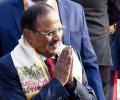
National Security Advisor Ajit Doval emphasized the need to strengthen India's security across all sectors, including the economy, to address historical vulnerabilities. He highlighted the sacrifices of freedom fighters and the importance of strong leadership.

Prime Minister Narendra Modi, in bilateral talks with Chinese President Xi Jinping, emphasized that both nations must show sensitivity to each other's core issues and be guided by mutual respect, sensitivity, and interest. Modi highlighted the critical importance of peace and tranquillity along the Line of Actual Control for the development of India-China relations, while also addressing concerns regarding Taiwan and Tibet.

Opposition parties, led by Rahul Gandhi and Mallikarjun Kharge, plan to march to the Supreme Court on Monday to meet the Chief Justice of India. They aim to submit a memorandum regarding alleged 'vote chori' and demand CEC Gyanesh Kumar's resignation, halting of SIR, and a return to paper ballots. The protest follows widespread detentions during previous demonstrations, which the opposition condemns as an assault on democracy.

US Vice-President J D Vance's unexpected phone call to Prime Minister Narendra Modi on August 8 has ignited speculation about a potential diplomatic overture, possibly seeking India's support amidst the escalating US-Iran conflict and a shifting global power landscape, suggests Ambassador M K Bhadrakumar.

National Security Advisor Ajit Doval has travelled to Russia to hold crucial talks on bilateral energy and defence ties and to prepare ground for Russian President Vladimir Putin's visit to India later this year.

Former CDS Anil Chauhan stated that China poses a long-term and comprehensive challenge to India, with the boundary issue remaining unresolved due to differing perceptions of the Line of Actual Control. However, he emphasised that India's ties with Beijing cannot be solely defined by border disputes, advocating for engagement through platforms like SCO and BRICS. He also highlighted the broader global geopolitical flux and instability in India's neighbourhood as significant security concerns, stressing the need for self-reliance.

Highly decorated police officer and former Intelligence Bureau chief Ajit Doval, considered one of the finest operational brains, was on Friday appointed as the national security adviser.

On Saturday, Prime Minister Narendra Modi and Chinese President Xi Jinping met on the sidelines of the BRICS Summit in New Delhi.

NSA Ajit Doval has indicated that dates for Russian President Vladimir Putin's visit to India are being worked out during his meetings in Moscow. Discussions also covered bilateral energy and defence cooperation, amidst ongoing concerns over India's procurement of Russian crude oil.
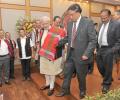
'He is still compulsively an operations man. Just a whiff of a live operation, and he is back in the field, at least in his mind. That is why the immediate decision to send the NSG to Pathankot.' 'But there is a difference between classical intelligence or counter-terror operation and dealing with a larger threat to a place as sensitive and sprawling as an air force base. This is what led to confusion and mix-ups,' says Shekhar Gupta.

In recent years, China and Russia have pushed for de-dollarisation within BRICS, which India has resisted. One reason is that India does not want to hurt its relationship with the United States, and another is the fear of China controlling trade because the renminbi is considered the strongest currency in the bloc today.

Doval briefed his counterparts in the United States, United Kingdom, Saudi Arabia and Japan about India's missile strikes against terror infrastructure in Pakistan and Pakistan-occupied Jammu and Kashmir. He also established contact with Russia and France, officials said.
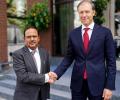
National Security Advisor Ajit Doval met with Russian First Deputy Prime Minister Denis Manturov to discuss bilateral military-technical ties and implementation of joint projects in strategic sectors. The meeting comes amid growing US pressure and tariffs on Indian goods.

China emphasises proper handling of differences and a long-term perspective for bilateral ties ahead of President Xi Jinping's visit to India for the BRICS summit and talks with Prime Minister Narendra Modi. The visit aims to stabilise relations following the 2020 Ladakh standoff and strengthen BRICS cooperation.

Chinese President Xi Jinping's upcoming visit to India for the BRICS summit is a pivotal diplomatic event poised to significantly impact bilateral ties and global cooperation amidst ongoing international instability.

Congress leader Rahul Gandhi has launched a scathing attack, calling Prime Minister Narendra Modi, Home Minister Amit Shah, and Chief Election Commissioner Gyanesh Kumar 'deshdrohis' (traitors) for allegedly 'destroying' India's voting system and 'stealing elections'.

'This is what we train for: That one chance to deliver a blow so lethal that the enemy will constantly think about it when planning any misadventure.'

National Security Advisor Ajit Doval met with Russian President Vladimir Putin in Moscow to discuss bilateral cooperation, reaffirming India's commitment to the relationship despite external pressures. Doval also extended an invitation from PM Modi for Putin to visit India later this year.

'How do we explain that on the economic, internal security and strategic fronts, India's unstable coalitions have acted more decisively and boldly than all our full-majority governments yet?' asks Shekhar Gupta.

Chinese President Xi Jinping is in New Delhi for the 18th BRICS Summit, where he is scheduled to hold bilateral talks with Prime Minister Narendra Modi. This visit, his first to India in nearly seven years, comes amidst efforts to normalise India-China relations following the 2020 Eastern Ladakh standoff and is expected to have significant implications for bilateral ties and BRICS cooperation.

Prime Minister Narendra Modi conveyed to Chinese President Xi Jinping that peace and tranquillity along the frontier remains an "essential" basis for the development of India-China relations, even as the two leaders welcomed "steady progress" in bilateral ties during their talks on the sidelines of the BRICS summit.

Sedwill also expressed solidarity with India in the aftermath of the Pulwama terrorist attack, they said, adding the call was initiated by the British NSA.

'The Indian strategy is to rope in the powerful Pakistan army in the negotiating spectrum. This can be done at the level of General Janjua, a former army commander,' reveals Rajeev Sharma.

National Security Advisor Ajit Doval hosted Bangladesh Foreign Minister Khalilur Rahman for a dinner meeting, signalling efforts to repair bilateral ties after a period of heightened diplomatic tension.
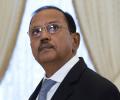
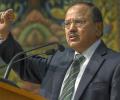
National Security Adviser Ajit Doval on Tuesday called for shunning double standards in combating terrorism and urged members of the Shanghai Cooperation Organisation (SCO) to hold accountable perpetrators, organisers and financers of cross-border terrorism, seen as reference to Pakistan.

Doval said India hit nine terror targets crisscrossing Pakistan with precision and missed none of them

This was the first round of talks for Wang after he succeeded State Councillor Yang Jiechi earlier this year.

National Security Advisor Ajit Doval stated that India-China relations have shown an "upward trend" in the past nine months, with peace prevailing along the Line of Actual Control (LAC). This statement was made during talks with Chinese Foreign Minister Wang Yi on the boundary issue, ahead of Prime Minister Modi's visit to China for the SCO summit.
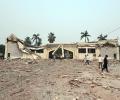
Former Chief of Defence Staff Gen Anil Chauhan (retd) revealed that Prime Minister Narendra Modi directed an 'unthinkable' and 'big lesson' action against Pakistan following the April 2024 Pahalgam terror attack, emphasising India's zero-tolerance policy for cross-border terrorism and the need for irrefutable evidence.

'The Modi government's pusillanimity vis-a-vis Pakistan makes almost certain that India will, in the coming weeks and months, be confronted with cross border terrorist actions of increasing intensity,' warns Satish Chandra, former deputy national security adviser.

It is about proving that the agency can still deliver when the stakes are high.

India has supported efforts to provide necessary humanitarian assistance to the Palestinian population in Gaza sending consignments of essential items.
Both countries also committed to formalising cooperation on cybersecurity policy and information sharing on cybersecurity issues.
National Security Advisor Ajit Doval will hold crucial talks with the top US leadership, including his counterpart Jake Sullivan, on the first high-level dialogue on Initiative for Critical and Emerging Technologies (iCET).

Uncover the real life figures that inspired the characters in Dhurandhar The Revenge, from Pakistani politicians and notorious gangsters to infamous terrorists.

National Security Advisor Ajit Doval on Monday emphasised the need to counter terrorism in all its forms for overall regional peace and stability during a meeting with Chinese Foreign Minister Wang Yi in Beijing.

India and China are in what experts call 'a cooperation-versus-competition situation'.
Manish Kumar Sinha has also alleged that the complainant in the case, businessman Sana Sathish Babu, had told him that Union minister Haribhai Parthibhai Chaudhari had been paid bribes to the tune of several crores of rupees for alleged help in matters related to CBI.

Afghan Foreign Minister Amir Khan Muttaqi arrived in New Delhi for a six-day visit, marking the first high-level trip from Kabul since the Taliban's takeover. He is scheduled to meet with Indian officials to discuss bilateral relations and regional issues.
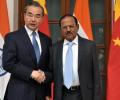
Wang also condemned the April 22 terror attack in Jammu and Kashmir's Pahalgam, which had cross-border linkages and triggered the worst fighting between India and Pakistan in years.
